
The Formation Sign 2025 - Click on cover thumbnail for a larger image
 |
FS 296 The first Formation Sign of 2025 includes articles on the newly-formed Royal Army Medical Service, the insignia of the Army's recruiters, the Royal Navy's equivalent of the Derby Scheme armband, a display of formation sign drawings for an unpublished series of cigarette cards, cloth slip-on titles from the First World War, some badges authorised by the Army Dress Committee last year - and in 1950 - a selection of badged battledress and some cloth badges connected with the war in Ukraine. And several other items of interest. |
 |
FS 297 This issue includes further information on the uniform and insignia of Army Recruiters and records some of the stations and outposts of Empire in which British soldiers found themselves in the 1920s and 1930s. A longstanding mystery badge is finally identified as that of a Free Polish brigade which served in Italy, a member appeals for help in finding an example of a Free Dutch sign, there is photographic evidence of the use of the 22nd Armoured Brigade stag head vehicle sign, detailed information on the post-war use of the Kiwi sign by New Zealand forces, a rare sighting of the Midlands Brigade on both battledress arms and further information on the aircrew wings worn by government departments in the 1950s and 1960s. |
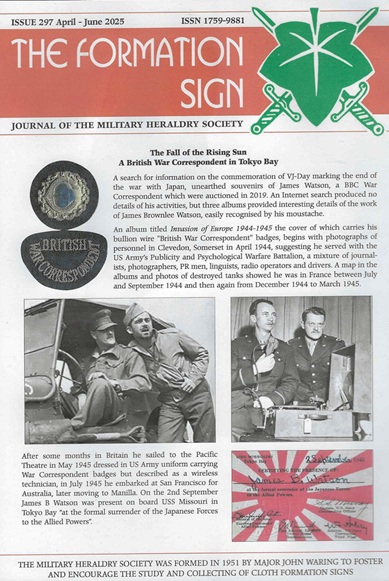 |
FS 298 This issue includes articles on Japan signing its surrender in 1945, the badges of Ukrainian Defence Brigades, Women Recruiting Sergeants, details of a planned lapel badge marking the wartime service of the Home Guard, a mysterious knocked-out tank badge, unofficial badges of RE Camouflage Companies, some weirdly badged battledress and details of the numerous Rainbow armbands worn by Civil Defence personnel. And a few other things..... |
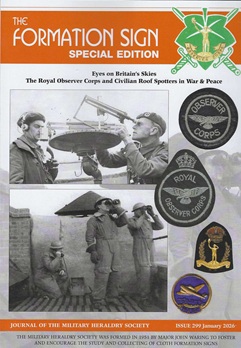 |
FS 299 Although the air raids of the First World War demonstrated the dangers to Britain which enemy air forces could cause, the defences were disbanded at the end of the war. Recognising that faster and heavier aircraft might cause damage in future wars, in 1925 a new organisation, the Observer Corps was created, its network of posts across the country designed to spot enemy aircraft and report their location to the Royal Air Force who would intercept them. On the outbreak of war in 1939 those manning the Corps' posts became full-time defenders and once German aircraft were stationed on the French coast, raids became frequent. The Battle of Britain showed the value of the Corps which in April 1941 became the Royal Observer Corps which was issued uniforms for its volunteers. This issue of the Formation Sign records and illustrates the tasks, equipment and uniforms of the Corps until disbanded in 1945 - then records its role and equipment during the Cold War, showing how they changed with the possible outbreak of Nuclear War. With Soviet forces no longer posing a threat the Corps was "Stood Down" in the 1990s. |